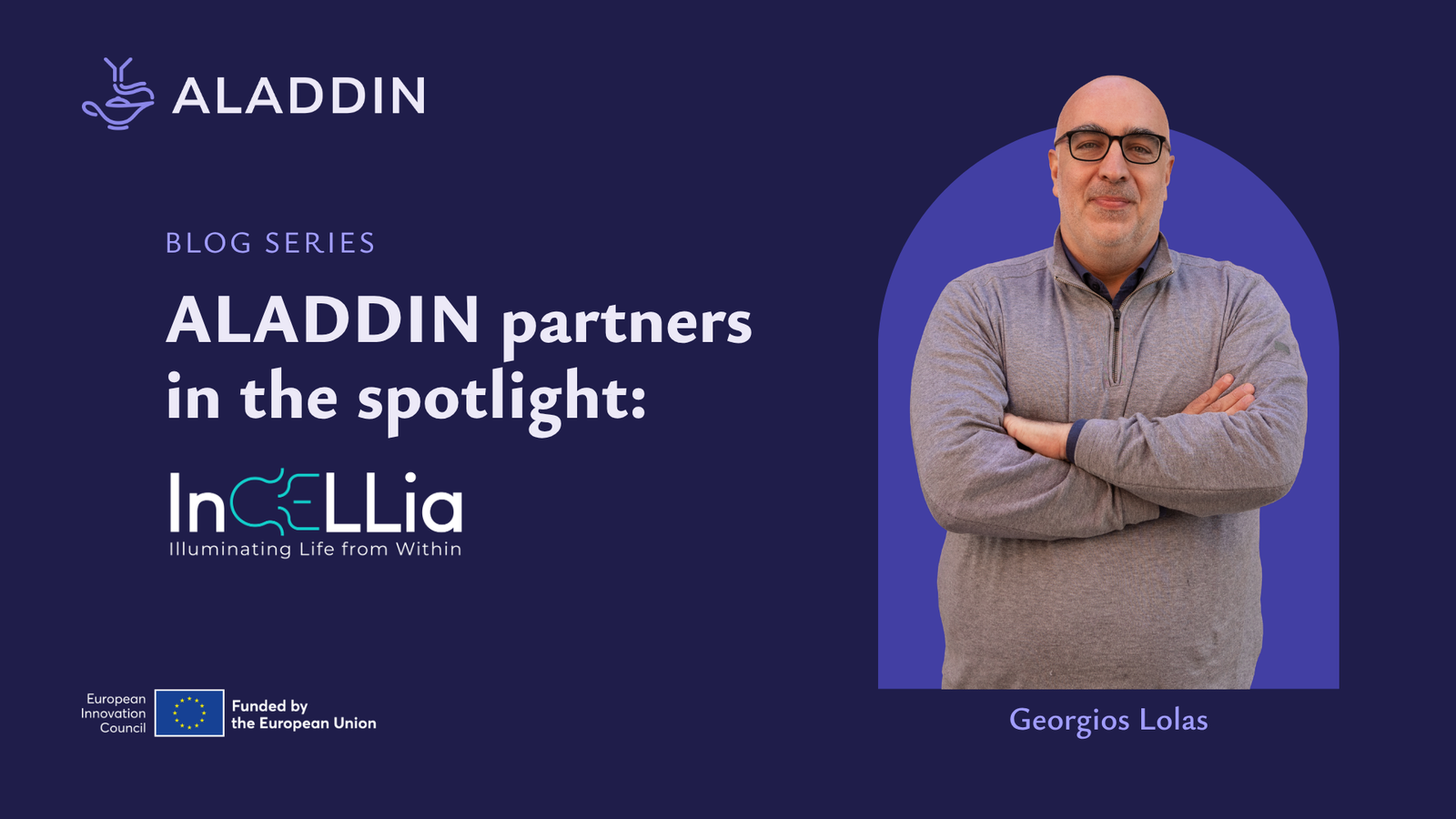
ALADDIN partners in the spotlight: InCELLiA
In the next article in our series spotlighting the ALADDIN project partners, we showcase the work of Athens-based startup InCELLiA. We interviewed its Founder and CEO Georgios Lolas about the role of mathematical modelling in cancer research and the impact it can have for the future of personalised medicine.
Mathematician Georgios Lolas founded InCELLiA in October 2021 as a result of interactions with oncologists at the Oncology Unit of the 3rd Department of Internal Medicine and Laboratory at the Sotiria General Hospital in Athens. Together with fellow mathematicians and electrical engineers, he felt that mathematics and machine learning could significantly help in predicting cancer progression based on the hospital’s available clinical data.
“Mathematical modelling unravels the mechanisms of biology. In InCELLiA, we are trying to combine these two aspects in one. We thought we would like to build something unique in Greece and Europe in this sector.”
Today, InCELLiA focuses on computational and mathematical mechanistic modelling for the pharmaceutical and health sectors, and is one of the eight partners of the ALADDIN project consortium.
Mathematical modelling complementing cancer research
In ALADDIN, InCELLiA uses mathematical and computational models integrating different clinical and experimental data for two purposes. First, it contributes to the identification and assessment of biomarkers and therapeutic targets in colorectal and pancreatic cancer. Second, it studies how the nanobodies developed in the project affect cancer evolution, from primary tumours to metastasis.
“We use mathematical models based on both the in vivo humanised zebrafish experiments as well as in vitro tests to build specific equations to see how the nanobodies or combination of treatments can affect tumour dynamics and mechanisms.”
Cancer research can benefit from in silico models, computer-based simulations used to study and predict the behaviour of complex biological systems. These models can help researchers explore how tumours respond to different treatments.
“We calibrate and try out different scenarios with the data we receive from the other ALADDIN partners. Based on what the mathematical models reveal, we can suggest that a different treatment dose could be investigated experimentally. This means that we can have fewer experiments, reducing costs and accelerating the process,” Lolas explains.
Making the complex simpler
Cancer is not a static disease. It is a dynamic and continuously evolving network with multiple layers. This also makes it challenging to model.
“We have different scales: the molecular level, the cell level, and the tissue level. This means we need to reveal the information from all these layers and still build a model that isn’t too complicated to manage. Complexity must be added slowly,” Lolas says.
This is also where mathematical modelling could contribute to personalised medicine, by helping researchers explore how treatment could be adapted to an individual patient’s characteristics and evolving tumour.
“The potential of these models is that we can develop adaptive therapies. We can individualise treatment based on each patient’s characteristics and data from experimental evidence.”
Lolas compares this to a weather forecast: just as forecasts use changing data to predict what might happen next, models could help adapt treatment as a patient’s tumour changes.
Clearly passionate about his team’s work, Lolas couldn’t think of a better project to put the power of mathematics into practice.
“ALADDIN is the perfect fit for InCELLiA, because we actually follow the whole experimental process from the beginning of the project. We combine the data from in vitro and in vivo models and clinical experiments and, in the long run, could assist clinicians to make a decision on which nanobody or treatment is the most beneficial for the patient. We are very honoured to be part of the project.”
Read other articles published in the ALADDIN partners in the spotlight series: